
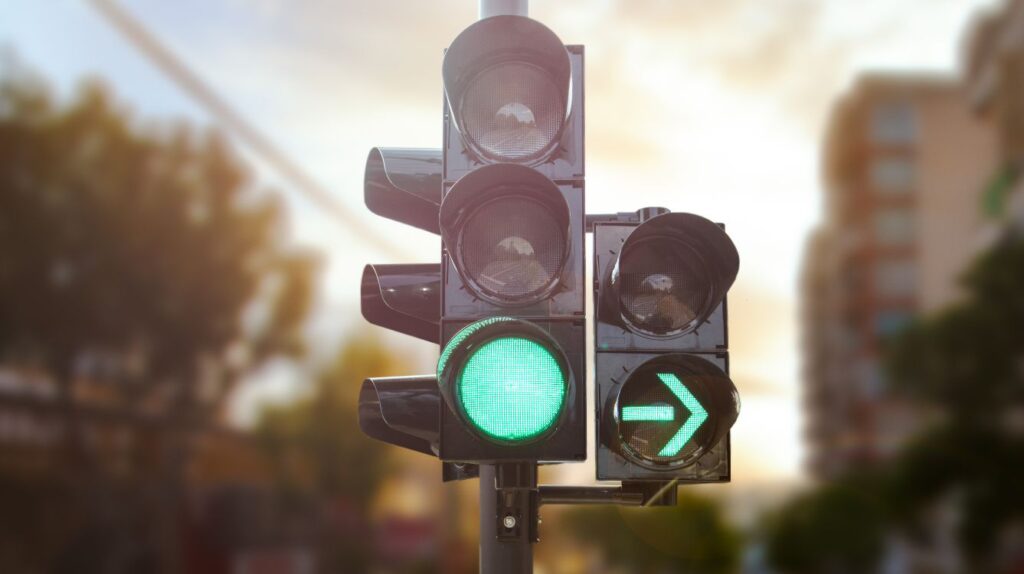
© Shotmedia / Shutterstock
Traffic lights are associated with road safety and saving lives, but unfortunately, in the 19th century, the first set exploded, seriously injuring a policeman. Despite their disastrous launch, they have evolved over the decades into a familiar means of regulating traffic flow at junctions all over the world.
Today’s computerised traffic lights are nothing like their Victorian predecessors, as the start of the digital age in the late 20th century made them far more versatile.
When did traffic lights start?
The fascinating history of traffic lights goes back to the reign of Queen Victoria, when horse-drawn carriages and bicycles filled our roads. Prior to this, police officers had been responsible for directing traffic in city centres in the early 18th century.
In 1722, they were tasked with ensuring smooth traffic flow across London Bridge as people travelled from London to Southwark and vice-versa. Each officer stood in the middle of the road at a strategic point, using a combination of hand signals, a hand-held “stop” sign and a whistle to direct the traffic and pedestrians. Much like today, much of the traffic related to commuters as they travelled to the service industries in the City or to casual labouring jobs on the quays.
London’s population grew rapidly from 750,000 people in 1760 to 1.4 million in 1815, with the traffic increasing correspondingly.
The first set of traffic lights in the world became operational in London on 9th December 1868. Lit by gas, they were erected outside the Houses of Parliament to control traffic flow around Parliament Street, Great George Street and Bridge Street.
Who invented traffic lights?
Designed by Nottingham-born railways manager John Peake Knight, his idea was inspired by the signalling systems used to manage the trains network.
The government realised something must be done to improve road safety after 1,334 people were killed and hundreds more suffered injuries on London’s roads in 1866. Knight invented a signalling system, using signs and lights, to control the horse-drawn traffic, ensuring drivers and pedestrians knew who had the right of way.
Built by well-known company Saxby and Farmer, whose founder, John Saxby, was known as the “father of signalling” due to his work with the railways; the location of the lights was at a junction considered a road safety hazard.
A large volume of traffic meant pedestrians risked life and limb by dodging between the fast-moving carriages in both directions. Originally called the “semaphore”, the traffic lights had moving arms that extended horizontally to advise drivers to stop or go. However, they weren’t automatic and were operated by a police officer, who turned a handle at the base of the column.
There were only two options on the 22ft high signal: to “stop” or to set off with “caution”. At night, the gas-powered lamps were lit, with the red light meaning stop and the green signalling go. Although they controlled traffic successfully, they were operational for less than a month when a terrible accident occurred.
Unfortunately, one of the underground gas lines that powered the signals developed a leak and on 2nd January 1869, the traffic lights exploded, with the policeman controlling them narrowly escaping death.
Despite the early issues, traffic signals had spread all over the UK and Europe and across the Atlantic to the United States by the early 20th century.
First electric traffic lights
The first electric traffic lights were invented by traffic officer Lester Wire, of Salt Lake City, Utah, in 1912, when he became head of the local Police Department’s Traffic Bureau. Initially, his groundbreaking invention was viewed with suspicion by the public, but they came to accept it as a useful idea.
The first three-coloured and four-way traffic lights were invented by Detroit police officer William Potts in 1920.
In 1922, the first electric traffic lights controlled by automatic timers were introduced in Houston, Texas. The first UK city to install automatic signals was Wolverhampton in 1927.
Wire continued to develop traffic lights until his death in 1958 and although he never patented his creation, his role in modern traffic management has been recognised.
Traffic light technology
As technology has advanced, so has the power of the traffic light.
Developed by Swedish company Sensys Gatso in 1964, the first traffic light cameras were aimed at improving safety by deterring motorists from jumping red lights. They had achieved worldwide popularity by the 1980s.
The camera is triggered when a vehicle goes through a red light, leading to financial and other penalties for the driver, such as points on their licence. As of May 2024, the current penalty for not stopping at a red light is three penalty points and a £100 fine.
The modern traffic light electronics circuit is made possible by technological advances in printed circuit boards. Reliable PCB assemblies are required to operate the automated lights sequence even in extreme weather conditions, with the coloured lights provided by LEDs.
Temperatures are often outside the operating standards of a typical PCB assembly such as in snow, freezing fog, or a heatwave. Traffic lights must also be able to withstand torrential rain, hail and everything else the weather can throw at them.
Reliable PCB connections, with minimum chance of failure, is crucial: the ensuing chaos if the traffic signals failed at a busy junction during rush hour could be disastrous.
Future of traffic lights
Improved traffic control measures are continually under development to make our roads safer.
Motor vehicles are becoming increasingly advanced due to the latest technologies and as a result, new PCB assemblies are expected to be developed that will enable stop lights to communicate with nearby vehicles through Smart technology.
The aim is to let drivers know when the lights are going to change. This will enable them to estimate how long their commute is likely to take, and they will also be able to navigate intersections more safely.
According to a report in Science Daily, published in March 2024, scientists at North Carolina State University have been experimenting with adding a fourth light to traffic signals. In addition to red, amber and green, they have suggested adding a “white phase” to tap into all autonomous vehicles’ computer systems.
The current traffic lights would still have the same meanings, but the white light would mean the signals were communicating with the onboard computers of every AV in the vicinity, with the aim of better coordinating the traffic flow through the junction by ensuring the lights were all operating at maximum efficiency. However, the research is still in its early stages, as the impact on pedestrians must be fully assessed before any pilot schemes can be considered.
Currently, researchers believe that if the adoption of AVs was “almost universal” in the future, delays at busy controlled junctions could reduce by more than 25% by deploying the “white light” technology.