
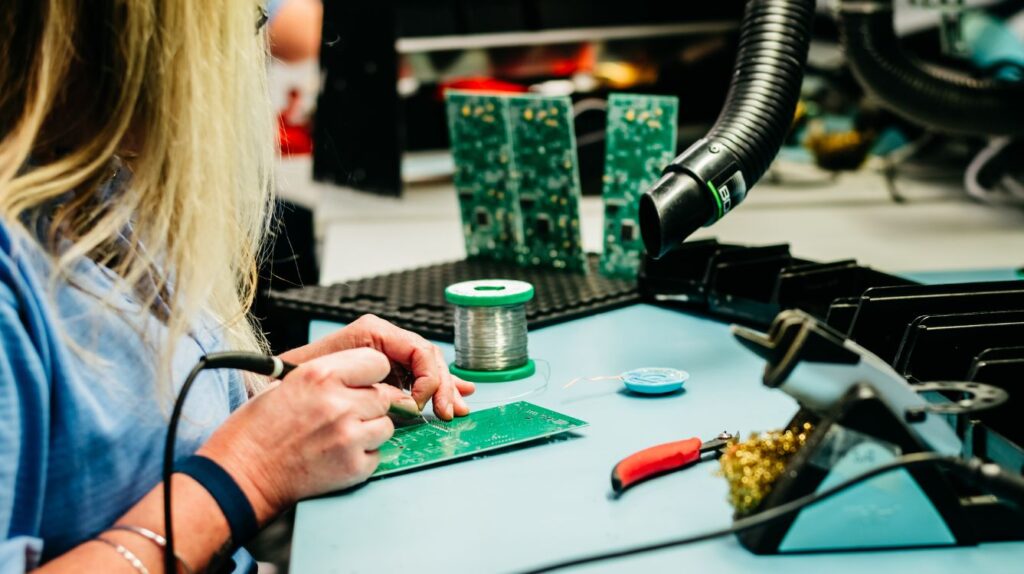
Image / Sellectronics
In electronics manufacturing, not every fault should result in a scrapped assembly, yet many original equipment manufacturers still view a component failure during testing as a costly setback.
This approach to a damaged pad, or a design revision discovered late in production, can create unnecessary waste, increased lead times and significant financial losses for companies working with complex, high-value electronics.
However, as the globally recognised standard for the reworking, modification and repair of electronic assemblies, IPC 7711/7721 provides a structured framework for restoring functionality and reliability without compromising the integrity of the printed circuit board.
For businesses operating in aerospace, defence, and other high-reliability sectors; a contract electronics manufacturers that holds certified IPC-7711/7721 expertise can deliver operational and financial advantages.
Understanding IPC-7711/7721
An internationally recognised benchmark developed by the Global Electronics Association, formerly known as IPC, the standard establishes detailed procedures that ensure corrective work is completed safely, consistently and to the same quality expectations as the original manufacturing process. It covers both surface mount and through-hole technologies and provides comprehensive guidance on component removal, replacement, conductor repair, pad repair, laminate restoration and assembly modification.
Unlike basic soldering, which focuses primarily on creating electrical connections, certified rework is a controlled engineering process. Every intervention must restore the assembly to its intended design integrity, while preserving the mechanical and electrical reliability of the PCB substrate.
This distinction is particularly important in sectors where failure is unthinkable, such as aerospace. A repair performed outside recognised standards may appear acceptable on the surface, but it can introduce hidden defects that only become apparent during field operation.
Scrapping high-value assemblies isn’t the only option
Modern electronic assemblies have become increasingly complex. Multi-layer PCBs may contain dozens of layers, fine-pitch components, Ball Grid Arrays (BGAs) and expensive microcontrollers with long procurement lead times.
The cost of scrapping such assemblies can be considerable. A single failed BGA, or damaged component can render an otherwise functional board unusable if appropriate rework expertise is unavailable.
For aerospace and defence programmes, where assembly costs can reach thousands of pounds per board, replacement can be significantly more expensive than repair. Certified IPC-7711/7721 technicians possess the necessary skills to rescue these assemblies through approved rework procedures, transforming what many manufacturers would consider a total loss into a recoverable asset.
The role of Engineering Change Orders
Engineering Change Orders (ECOs) are a routine reality in electronics manufacturing. Hardware designers frequently identify improvements during testing, validation, or early production runs that require modifications to an existing assembly.
Without a robust rework capability, implementing these changes may require an entire production batch to be scrapped and rebuilt. The resulting costs include materials and labour to include schedule delays, procurement challenges and production disruption.
Under IPC-7711/7721, certified technicians can perform trace cuts, install jumper wires, modify circuit paths and replace components while maintaining compliance with quality requirements. This allows manufacturers to introduce design improvements rapidly, without incurring the expense of a complete production re-run.
Protecting scarce and high-value components
Supply chain volatility has become a defining challenge for electronics manufacturers over recent years. Semiconductor shortages and global logistics disruptions have made certain components difficult and expensive to source.
When a board contains a high-value microcontroller or processor with a lead time measured in months, scrapping the assembly may represent a financial loss and remove access to a component that can’t be replaced easily.
Certified IPC-7711/7721 processes allow technicians to carefully desolder, recover and reuse valuable components from flawed assemblies. These parts can then be installed onto new boards, or incorporated into corrected builds.
This capability can be a commercial lifesaver. Recovering scarce components protects production schedules, reduces purchasing pressure and minimises exposure to supply chain uncertainty.
Difference between standard soldering and certified rework
There’s a significant difference between replacing a component with a soldering iron and carrying out a certified IPC-7711/7721 repair. Improvised repair techniques often rely on excessive heat or uncontrolled processes. While these methods may appear successful initially, they can introduce hidden damage within the PCB structure.
Excessive thermal exposure can cause delamination between PCB layers, lift pads from the substrate, damage vias and create microscopic cracks that may emerge later during vibration, thermal cycling, or long-term service.
The certification addresses these risks through documented procedures, approved tools and strict process controls. Every repair is performed using methods designed to preserve the board’s mechanical and electrical characteristics while restoring functionality. The result is a PCB assembly that performs as intended.
How Sellectronics delivers precision rework solutions
As a specialist in high-reliability electronics manufacturing, Sellectronics goes beyond basic soldering to provide certified, non-destructive rework solutions that align with IPC-7711/7721 requirements.
Our highly trained, multi-skilled team holds specific credentials, ensuring every repair, modification, or rework is completed to a repeatable and audited standard. Whether replacing microscopic 01005 passive components, repairing damaged surface mount pads, or carrying out complex BGA rework, each intervention follows established industry procedures.
We treat rework as a controlled engineering process, rather than a reactive repair activity. Full traceability is maintained throughout every stage, supporting compliance requirements for industries where documentation and quality assurance are essential. This disciplined approach helps preserve the long-term lifespan of assemblies, ensuring they continue to meet stringent performance requirements.
Business case for IPC-7711/7721 expertise
By reducing unnecessary scrap, organisations lower material costs and improve resource utilisation. Effective repair and modification techniques extend product life, maximise component value and minimise waste.
The standard also enhances workforce capability by establishing recognised skill requirements and ensuring technicians possess the expertise necessary to perform complex repairs correctly. Inspection and testing requirements provide additional assurance that reworked assemblies continue to meet original performance specifications.
For OEMs facing increasing pressure to reduce costs, certified rework capabilities represent a practical and proven solution. This has become an essential strategic capability, rather than simply a repair function.