
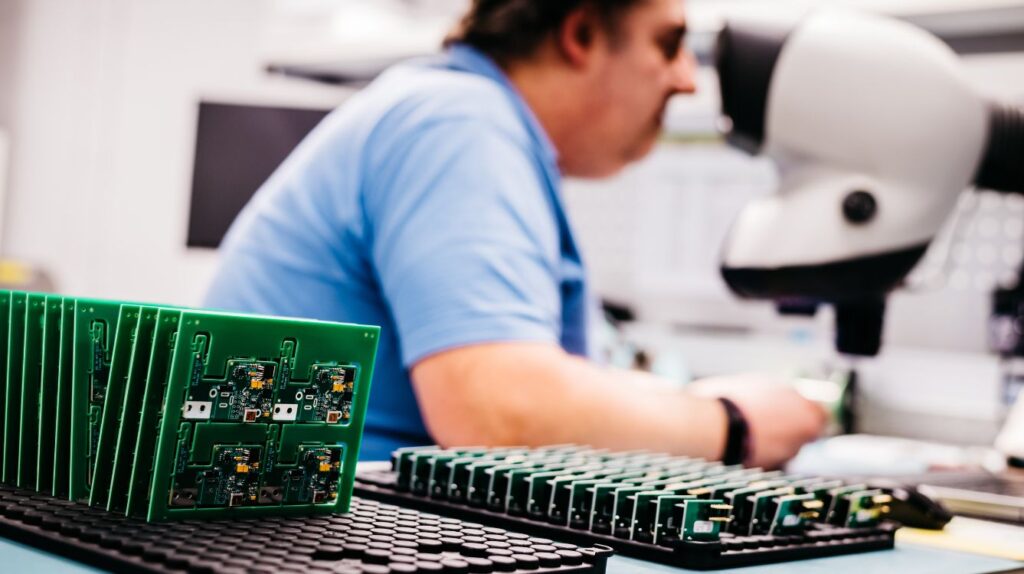
In the aerospace industry, electronic systems powering aircraft, satellites and defence technologies must perform reliably under some of the most extreme operating conditions on earth and beyond. Every component, connection and line of code has to function perfectly, because lives and missions depend on it.
Aerospace PCBs are held to a much higher standard than those used in consumer, automotive, or even industrial applications. In a world of unforgiving environments and zero tolerance for failure, the PCB is critical to every mission.
What sets aerospace PCBs apart?
The climate endured by aerospace PCBs is unlike any other. The boards must perform reliably in high-vibration conditions, temperature fluctuations and exposure to radiation, humidity and corrosive materials. Whether in the vacuum of space, or cruising at 35,000 feet, these systems must operate flawlessly, often for years with minimal maintenance.
Aerospace systems commonly require high-density designs with multiple layers, controlled impedance, extreme tolerances, consistency and traceability. This level of performance is the result of a precise and rigorously documented process that begins at the design stage and continues through manufacturing, testing, delivery and installation.
Understanding AS9100 and its importance
To manage this complexity and mitigate risks, the aerospace industry relies heavily on quality standards. None is more foundational than AS9100, a quality management system tailored specifically for aerospace and defence. Industry standards build on the ISO 9001 framework, while introducing additional requirements critical to flight safety.
AS9100 includes expectations for risk management, configuration control, traceability, product safety and counterfeit part prevention. The most recent revision, AS9100D, places a greater emphasis on proactive risk identification, process performance and customer satisfaction. It’s about building quality in at every stage.
For any company involved in contract electronics manufacturing for aerospace, being AS9100 certified represents a commitment to these quality systems and the kind of operational discipline that aerospace customers expect.
Why certification matters in the supply chain
The aerospace supply chain is intricate and highly interconnected: a failure in one link can ripple across multiple systems, leading to production delays, or worse. This is why aerospace prime and Tier 1 suppliers often require every company in their supply chain, including those providing PCB assembly services, to be AS9100 certified.
Certification ensures everyone is following the same rules when it comes to documentation, materials handling and change control. It demands adherence to a formal, structured process to manage any modifications to products and processes after the initial design or production has begun. When a contract electronics manufacturer is certified, their customers can trust that each board will meet specifications every time. This trust can speed up approvals, reduce overheads and enhance long-term partnerships.
At Sellectronics, we maintain both AS9100D and BS EN ISO 9001 certifications across our facilities. It’s our way of ensuring that every PCB we deliver meets the same high standards.
Sellectronics: aerospace electronics manufacturing specialists
As a leading contract electronics manufacturer, we are proud to serve aerospace companies with services designed specifically for high-reliability applications. We work with clients across defence, commercial aviation and space sectors, supporting projects from early stage prototyping to full-scale production.
Our full turnkey service manages everything from component sourcing and procurement to manufacturing, inspection and final testing. Experienced in the demands of aerospace PCBs and, our team provides designs for manufacturability (DFM) input to optimise your board. We also recognise the critical nature of security, with our operations structured around confidentiality and discretion. All projects are handled under strict NDAs, and we maintain tight control over intellectual property and supplier data throughout the production process.
Civil aerospace requirements: a closer look
PCBs for civil aerospace must comply with a broad spectrum of national and international standards. In addition to being AS9100 certified, manufacturers must align with specific regulations from aviation authorities like the Federal Aviation Administration in the US and the European Union Aviation Safety Agency.
For example, rigid aerospace PCBs typically adhere to IPC Class 3 requirements, which define the highest level of performance and reliability. Additionally, specifications such as IPC-6012ES provide guidelines tailored specifically to aerospace and military rigid board production.
Companies must demonstrate complete traceability of materials and processes. This includes following inspection and documentation protocols, often beginning with First Article Inspection Reports (FAIR) in accordance with AS9102. This verifies that every detail, from material properties to hole diameters, meets the customer’s design.
Civil aviation authorities place significant emphasis on documentation. Without it, approval for flight-critical electronics becomes nearly impossible. That’s why choosing an experienced partner like Sellectronics, who understands both the letter and the spirit of these standards, is a strategic advantage.
Environmental testing: a crucial step in validation
Reliability in aerospace electronics isn’t just about the materials or layout: it’s about performance under pressure. This is where environmental testing comes into play. These tests simulate the real-world conditions a PCB will experience throughout its operational life. Typically, this includes thermal cycling to verify tolerance to rapid changes in temperature, humidity exposure to ensure resistance to corrosion and delamination, and vibration testing to assess mechanical robustness under intense motion. Electromagnetic interference (EMI) testing is also conducted to ensure functionality in environments filled with radiofrequency and electronic noise.
These tests are not optional, they are essential. Every result must be documented and traceable, often forming part of the final inspection or certification.
Materials and coatings: designed for the long haul
Using high-temperature laminates, low-CTE substrates and robust copper structures ensures the PCB can withstand the thermal and mechanical demands of flight or launch. Flame-retardant materials, typically rated to UL94 V-0, add another layer of protection in safety critical applications.
Many aerospace PCBs also receive a conformal coating to shield the board from moisture, chemicals and other contaminants. Its adhesion to the soldermask must be verified to ensure long-term durability. At Sellectronics, we have extensively tested and approved specific soldermask and coating combinations to meet these challenges head-on.
Our process also includes the use of IPC AABUS (As Agreed Between User and Supplier) clauses to define custom requirements that may exceed traditional IPC standards. This flexibility allows us to tailor every job to the specific reliability and cost-effectiveness our clients’ need.
End-to-end aerospace manufacturing
What sets Sellectronics apart is our holistic approach to contract electronics manufacturing. We aren’t just a PCB assembler: we’re a partner in your product development and delivery. Our team provides insight during the design phase, guides material selection, ensures efficient sourcing and manages every stage of production with aerospace standards in mind.
Whether the project involves a few complex prototypes, or a full-scale production run, we apply the same level of care and commitment. As an AS9100 certified contract electronics manufacturer, we understand what’s at stake.
When your mission requires absolute reliability, you need a partner who delivers precision and performance every time. To find out more, contact us today and build something that lasts.