
Image / Sellectronics
The aerospace and defence sectors are undergoing a significant transformation. Alongside long-standing demands for safety, reliability and precision, organisations are now under increasing pressure to demonstrate meaningful progress on sustainability. Customers, regulators and partners expect reduced environmental impact, responsible supply chains and transparent governance.
At the centre of this shift sits AS9100 certification, the internationally recognised quality management standard for the aerospace industry, which is increasingly being used as a framework to support both quality and sustainability objectives.
AS9100 was originally developed to address the rigorous requirements unique to aerospace and defence. It introduces additional controls around risk management, configuration control, product safety and traceability. Crucially, it also embeds continual improvement into day-to-day operations, encouraging organisations to review performance, identify inefficiencies and adapt to emerging risks. It has evolved into a powerful enabler for wider business goals, including environmental and social responsibility.
Sustainability as a strategic priority
The aerospace industry is responsible for a significant environmental footprint, from energy-intensive manufacturing processes to complex global supply chains. According to industry estimates, aerospace manufacturing accounts for millions of tonnes of CO2 emissions annually, prompting governments and prime contractors to impose stricter environmental requirements on suppliers.
Beyond emissions, there’s growing scrutiny around waste generation, material usage and handling hazardous substances. Defence programmes often run for decades, meaning decisions made at the manufacturing stage can have long-term environmental consequences. As a result, high standards are increasingly expected to support waste reduction, resource efficiency and lifecycle thinking, while maintaining stringent levels of quality and safety.
How important is AS9100?
Although not an environmental standard in itself, its structure strongly supports sustainability initiatives. One of the most significant contributors is process control. By requiring organisations to define, monitor and continually improve their processes, AS9100 helps reduce variation, rework and scrap. Fewer defects mean less wasted material, lower energy consumption and reduced disposal of electronics products.
Risk-based thinking, introduced formally in Clause 6.1, also plays a critical role. Aerospace organisations are increasingly incorporating environmental risks into their quality management systems such as the availability of raw materials, exposure to hazardous substances and carbon-related regulatory risks. By identifying and mitigating these risks early, companies can take proactive steps towards more sustainable operations.
Supplier control is another area where AS9100 is useful. The standard requires thorough evaluation and monitoring of suppliers, allowing organisations to assess quality performance, environmental practices and ethical sourcing. This is particularly important where complex, multi-tier supply chains can significantly influence overall environmental impact.
Waste reduction and environmental impact
Operational efficiency is a cornerstone of AS9100 compliance and sustainability. Improved planning, controlled documentation and disciplined change management all contribute to smoother production flows and reduced waste. For electronic manufacturers operating in regulated sectors, AS9100 also encourages data-driven decision making.
Performance metrics, corrective actions and management reviews provide visibility into inefficiencies that might otherwise go unnoticed. This focus on evidence and accountability supports environmental goals by ensuring sustainability initiatives are measured, reviewed and continuously improved, rather than treated as one-off projects.
The future of aerospace standards
AS9100 is increasingly viewed as a foundational framework for integrating environmental, social and governance principles into aerospace and defence organisations. While earlier revisions focused almost exclusively on safety and reliability, Rev D enables broader considerations through its emphasis on leadership, organisational context and stakeholder needs.
Many aerospace organisations are leveraging the standard to support circular economy principles, such as designing products for disassembly, reuse, or recycling and conducting lifecycle assessments to understand environmental impact. These practices are becoming essential as customers demand greater transparency and regulators tighten environmental legislation.
Looking ahead, the transition from AS9100 to IA9100, expected in late 2026, will further strengthen the link between quality and sustainability. The next evolution of the standard is expected to align more closely with ISO 9001:2026, with increased emphasis on climate change considerations, ethical behaviour, human factors and data integrity.
Integrating AS9100 with ISO 14001
Many organisations enhance the sustainability benefits of AS9100 by integrating it with ISO 14001, the international standard for environmental management systems. While AS9100 ensures robust quality and risk management, ISO 14001 provides structured tools for managing environmental impacts, setting environmental objectives and ensuring compliance with environmental legislation.
This integrated approach allows aerospace companies to align quality and environmental objectives, rather than managing them in isolation. It also supports more efficient audits, clearer responsibilities and stronger engagement from employees. Companies listed in the Online Aerospace Supplier Information System, commonly known as the OASIS database, are increasingly expected to demonstrate this kind of combined approach to quality and sustainability.
Sellectronics holds AS9100D and BS EN ISO 9001 certifications, demonstrating a clear commitment to robust quality management systems. In addition, ISO 14001:2015 certification highlights a proactive approach to environmental performance, reinforcing our alignment with sustainability goals.
Quality engineering is central to our approach, with a multi-skilled and flexible team ensuring that high standards and a quality product remain part of the business plan. This focus not only supports demanding aerospace standards, but also reduces waste and inefficiency.
Reliability testing and advanced capabilities
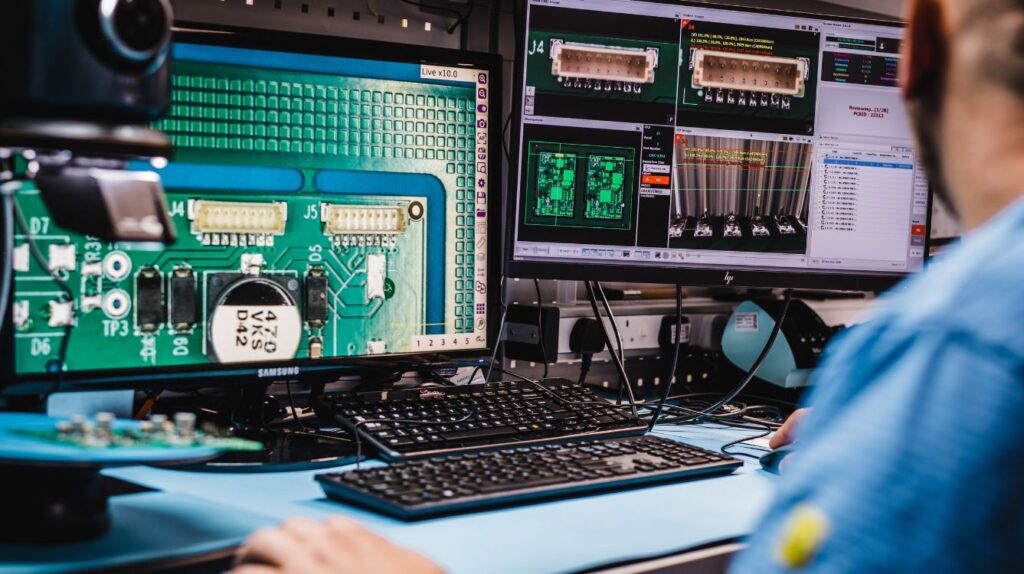
We have worked closely with customers for many years to develop robust test strategies that support both external and in-house requirements for PCBAs and sub-systems. Effective testing reduces the risk of field failures, extending product life and avoiding the environmental cost of repairs, replacements and recalls.
Our testing capabilities include in-circuit test, boundary scan, functional test solutions, bespoke test fixtures, 19-inch rack testing, LabVIEW functional testing and outsourced X-ray inspection. These services support thorough validation while minimising unnecessary rework, contributing to more efficient use of materials and energy.
Dedicated & customer-focused approach
From receipt of an enquiry through to final delivery, our dedicated customer-focus team oversees full product realisation. This integrated approach spans engineering, customer service, programme management, supply chain and operations, ensuring clear communication, reduced errors and streamlined processes. This level of control is particularly valuable for customers seeking an electronics manufacturer UK partner capable of supporting aerospace and defence programmes.
AS9100 certification plays a crucial role in helping aerospace and defence organisations meet the twin challenges of uncompromising quality and sustainability expectations. As the standard continues to evolve toward IA9100, its role in supporting sustainability will only strengthen. For contract electronics manufacturers UK-wide, AS9100 is increasingly a bridge between quality excellence and a more sustainable aerospace and defence industry in future.