
© Nan_Got / Shutterstock
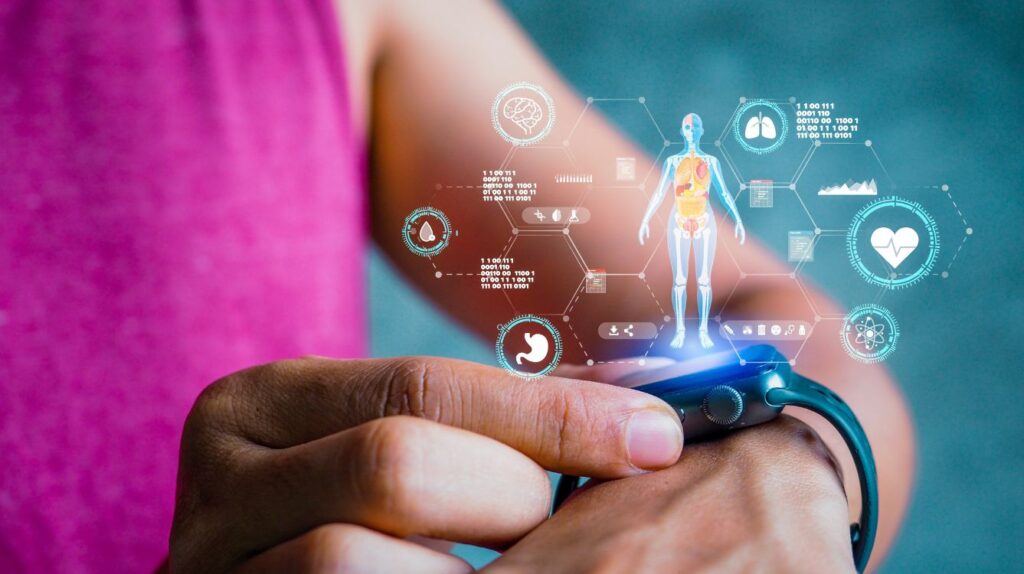
According to experts, wearable technology is set to become more integrated into our lives, thanks to multiple applications in fitness, healthcare, fashion, artificial intelligence and more.
Current trends suggest the future of wearables will span many different sectors in the not-too-distant future, with the results having a positive effect on our health, finances and quality of life.
What is wearable technology?
Initially, critics argued wearable technology was a fad, but it has gone from strength to strength, with the global market value expected to increase to £203 billion by 2026 – a growth of 41% since 2022.
The technology has come a long way since Dr Yoshiro Hatano and his research team at Kyushu University of Health and Welfare, in Japan, invented the first wearable health tracker in 1965 to fight obesity.
In the 21st century, the most well-known wearable technology is the Fitbit fitness tracker, launched in 2009. Designed to clip onto clothing to track distance, steps, hours of activity and calories used, it revolutionised the health and fitness industry.
Today, wearables are evolving into a means of improving efficiency in many sectors including health, fitness, education, emergency services, travel, entertainment and more.
Wearable technology trends
Many wearables trends are connected to health management and patient care. In future, they may be used to assist with the early diagnosis of medical conditions, helping to reduce healthcare costs by improving the accuracy of information, and streamlining procedures.
AI-powered wearable technology can provide predictive health insights and personalised recommendations, while smart clothing containing embedded sensors could track environmental conditions and biometric data, helping to improve comfort.
In the manufacturing and construction industries, wearable tech will provide real-time guidance to construction workers to reduce downtime, with exoskeletons helping employees to lift heavy objects, which should go towards reducing injury risks. The aesthetic appearance has always been important, as attractive products are traditionally desirable to consumers. Wearable products must be functional and look the part too.
Advances made by 5G technology will continue to improve the capabilities of wearables by enabling them to transmit and process data more efficiently. The main challenges include miniaturisation, power efficiency, durability and user comfort, which are being addressed through innovations in PCBs, flexible materials and advanced power management.
Miniaturisation
The miniaturisation of wearable electronic devices offers many benefits including being more comfortable and lightweight, and improving convenience for users. However, it also brings its own challenges: PCB assembly plays a crucial role in the technology’s success.
Printed circuit boards are getting smaller and more flexible as PCB assemblers create designs that are capable of integrating more components. This allows wearables to be compact and versatile, with resistors, transistors and capacitors being integrated into a small semiconductor chip.
The main objective is to increase the PCB’s component density, reducing the overall weight and size of electronic devices. The result is better functionality in a smaller space to meet consumer demands.
Power efficiency
Advances in power efficiency are critical for the future of wearables. New innovations in energy harvesting such as kinetic, solar and thermal power, combined with PCB power management to improve battery life, are the key.
Kinetic energy can improve the effectiveness of wearable technology, as long as the energy-harvesting circuits are able to perform efficiently with the low frequency pattern produced by human motion. PCBs that can support a harvesting system optimised for these frequencies are the way forward.
Photovoltaic devices to transform sunlight into electricity, functioning as a solar power supply, can be seamlessly integrated as components within PCBs for wearable devices. Organic solar cells can achieve a power conversion efficiency sufficient for wearable electronics to function, while enabling high flexibility and portability.
When designing PCBs, thermal management is vital to ensure the wearable device is efficient and reliable. PCBs can use materials that have high thermal conductivity such as aluminium, copper or ceramic. Using between four and eight layers can provide enough power planes.
Advancements in semiconductor manufacturing processes have enabled the miniaturisation of transistors, so more can be placed onto a single chip to increase processing power and energy efficiency.
Durability
Wearable technology is tested for durability to ensure devices maintain their structural integrity and functionality over time. Using flexible PCBs can enhance the long-term performance of wearables, while rigid electronic components may hinder their ability to bend and flex, ultimately leading to a shorter lifespan.
The battery life of wearable technology can impact its long-term durability, so a battery protection PCB can help to extend battery life by protecting it from short circuits, overheating, undervoltage and overcharging.
User comfort
A flexible circuit board can reduce a device’s weight by up to 70%, making it more comfortable and less noticeable. It can also bend and be folded into a smaller shape to reduce the product’s overall size, or mirror the body’s shape.
Flexible PCBs are commonly made from materials such as polyimide and are used in wearables such as fitness trackers, smartwatches and medical devices. They can ensure the devices are reliable and efficient, as well as compact and lightweight.
Medical-grade wearables
Medical-grade wearables in healthcare include glucose monitors and cardiac patches. Flash glucose monitors comprise a small sensor worn on the arm to provide information on glucose levels via a mobile app.
Another type, continuous glucose monitors, involves a small sensor being inserted in the skin, usually on the stomach or arm, to measure glucose levels, with the data being sent to an insulin pump, phone or other device.
Both types can identify changes in blood sugar, enabling users with diabetes to work with their healthcare professional to adjust the insulin administered. An alarm can be set to go off if the blood sugar level goes too low or too high.
Emerging wearable technology includes augmented reality glasses for use in healthcare, gaming, education, engineering and entertainment. AR glasses can be used as leisure time entertainment, or for training simulations in the workplace. They can be used for navigation, communication and in healthcare to provide real-time captioning for people with hearing loss.
Brain computer interfaces are being developed for mapping, researching, assisting, augmenting and repairing patients’ sensory-motor or cognitive functions. A BCI provides a direct line of communication between the brain’s electrical activities and a device such as a computer or robotic limb. It can acquire signals from the brain, analyse them and convert them into commands, enabling an output device to carry out the chosen actions.
Future of wearable technology
Innovation in wearables is continuing at a rapid rate, producing devices such as the Lumo Lift, worn under the collarbone to monitor spinal position and upper body to improve posture.
Sports players can wear the Catapult Playr Smart Football Tracker, a vest that analyses and improves their performance by tracking distance, speed and sprint intensity. Sensoria Smart Socks have sensors stitched into the feet, linking to the wearer’s smartphone via Bluetooth to monitor pace, landing, speed, calories burned and other performance indicators. Nadi X Smart Yoga Pants are embedded with technology to sense body movements, using haptic vibrations to improve alignment and posture.
The possibilities are endless, with the evolution of PCBs playing a pivotal role.