
© Parilov / Shutterstock
New technologies being developed for military and defence applications are revolutionising the national security sector, with printed circuit boards being at the forefront of their design.
Surveillance drones, communication systems and autonomous vehicles are just some of the innovations made possible by advanced technology, with PCB assembly creating increasingly complex solutions.
Importance of military technology
The defence industry is responsible for national security, providing early warning and threat detection using military communication systems. All military technology requires a reliable and compact foundation, based on electrical components.
Prior to the use of PCBs, electronic circuits were wired to a chassis in the shape of a metal sheet or pan, with components with insulators attached. Some early work on printed circuit boards had begun in the early 20th century, when Albert Hanson, a renowned German scientist and inventor, designed a primitive circuit board to improve the quality of telephone exchange boards. His work had begun as early as 1903, with innovations including through-hole construction that was the precursor of modern plated through hole PCBs.
Groundbreaking advances in PCB development began in the 1940s, when attention turned to technology in the military following Japan’s devastating attack on Pearl Harbour in December 1941. The surprise attack on the American naval base led to the US formally entering World War II in support of the Allies.
Subsequently, the first fully functional printed circuit board was created by Austrian engineer Paul Eisler, who used a layer of copper foil to establish a conductive pathway for electronic components. In 1943, he developed a radio for military use, equipped with a PCB – an invention that was integral to the Allies’ military operations for the remainder of the war.
During the post-war years, further developments gathered pace, with today’s use of PCB prototyping enabling manufacturers to launch innovative projects quickly. They can test the functionality of new designs, check for bugs and update the product if required, offering quality assurance before going ahead with a full production run.
Modern innovations using the latest complex PCBs have had a significant impact on military and defence operations, with three applications in particular being the key to modern national security.
Surveillance drones
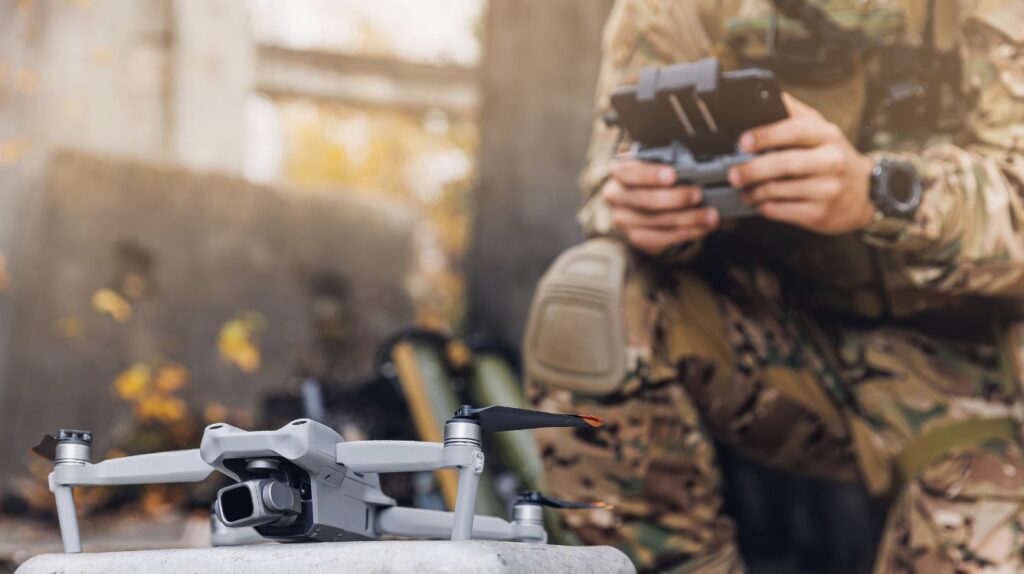
Surveillance drones are a useful tool for military organisations, governments and private companies to improve security and carry out defence missions. Thanks to advances in technology, vertical take-off and landing unmanned aerial vehicles provide an alternative to putting personnel at risk on hazardous missions.
With military grade capabilities, improved sensors and longer flight times, military UAVs have many benefits for defence and security applications. They can collect data remotely and stealthily, minimising the risks to personnel who may otherwise have to fly over dangerous sites themselves to perform the same tasks.
Remote control systems and long-range surveillance capabilities mean drones can fly entirely autonomously, or they can be operated long-distance, allowing defence organisations to collect data from hazardous environments. Some even contain a security feature that prevents hostile interference such as protecting sensitive information, including the operator’s location.
It’s easy to transport and collect a drone, having it ready for the surveillance operation within minutes. No runway is needed for take-off or landing, so it can be deployed from almost any environment.
Drones have a low operational cost when compared with satellite imagery or a manned aircraft, enabling aerial mapping and surveillance at a fraction of the price.
The PCB must be waterproof so it can withstand the environment, including flights in rain and other harsh general weather conditions. The board is a basic drone shape made from a lightweight material, with fibreglass being a popular choice.
Communication systems
Printed circuit boards are a vital component in military communication systems, enabling users to send and receive signals across different distances and frequencies. Used in radios, radar, satellite communication systems and tactical communications, PCBs for defence applications require high-frequency materials with a low dielectric constant. This provides greater reliability and improved performance, reducing interference and signal loss and enabling users to transmit electromagnetic signals at microwave frequency.
The circuitry can be complex and includes amplifiers, filters, mixers and oscillators designed to maintain signal integrity at high frequencies, while withstanding electromagnetic interference.
Military communication PCBs integrate the latest signal processing technology, such as application-specific integrated circuits and digital signal processors, enabling real-time data analysis for enhanced reliability and performance in battlefield environments.
Technology is continuing to advance, so the PCB’s contribution to communication in the military and defence sector is evolving continually. This is creating a rising demand for further high-tech electronics, which means PCB manufacturers must use evermore advanced materials and functionality for greater adaptability and performance.
AI and machine learning is also increasingly integrated into military radar systems, using PCBs that include specialist hardware accelerators. Integrating AI into the PCBs of military communication systems is driving innovation forward to improve effectiveness when facing operational challenges and threats.
Autonomous vehicles
The British Army has been experimenting with autonomous vehicles since 2022 as part of Project Theseus to find better ways of delivering supplies to troops on the battlefield. Known as the “last mile”, the journey to soldiers on the frontline is particularly hazardous, but necessary to deliver food, ammunition, fuel and other vital supplies.
Project Theseus is determining whether driverless vehicles, both on the ground and in the air, can reduce the need for human drivers to risk their life venturing into war zones. Autonomous and robotic systems look set to play a bigger role in delivering supplies, not only saving lives, but also improving the Army’s capabilities by increasing the volume and speed of resupplying those on the frontline.
The first demonstration of automated vehicles took place in December 2021, when the Nuneaton company, Horiba Mira, unveiled its autonomous range of vehicles. These included dropping ammunition supplies from an unmanned aerial vehicle and a dummy casualty evacuation over land, loading soldiers onto a platform and having them transported safely on an autonomous vehicle back to the command station.
Project Theseus is part of wider autonomous systems and robotics research being carried out by the Army’s Expeditionary Robotics Centre of Expertise. A growing trend for lightweight design in military and defence applications means PCB manufacturers are having to evolve their products to ensure they are both compact and efficient. They must continue to operate effectively in harsh conditions, including temperature extremes, rain and snow, vibrations and shocks. Rugged, yet lightweight, this new breed of PCBs meets these specific requirements.